 Brentwood Electrical Services
Guide
How Long an EICR Takes and What Is Involved
An EICR on a typical three-bedroom house usually takes a few hours. Here is what the electrician checks, what affects the time and what happens next.
- Send a short enquiry
- Covering Essex
- EICR and related services
An EICR on a typical three-bedroom house usually takes a few hours, and larger or older properties can take a full day or more. The electrician inspects and tests the fixed wiring and then gives you a written report on its condition. Brentwood Electrical Services provides EICRs for homes and commercial premises in Brentwood and across Essex.
What EICR stands for and what it covers
EICR stands for Electrical Installation Condition Report. It is a formal check of the fixed electrical installation in a property: the consumer unit (fuse board), the circuits, the sockets, switches and light fittings, and the earthing and bonding.
It is not the same as PAT testing, which covers portable appliances such as kettles and lamps. An EICR looks at the wiring and equipment built into the building. Plug-in items are not part of it.
What happens during the inspection
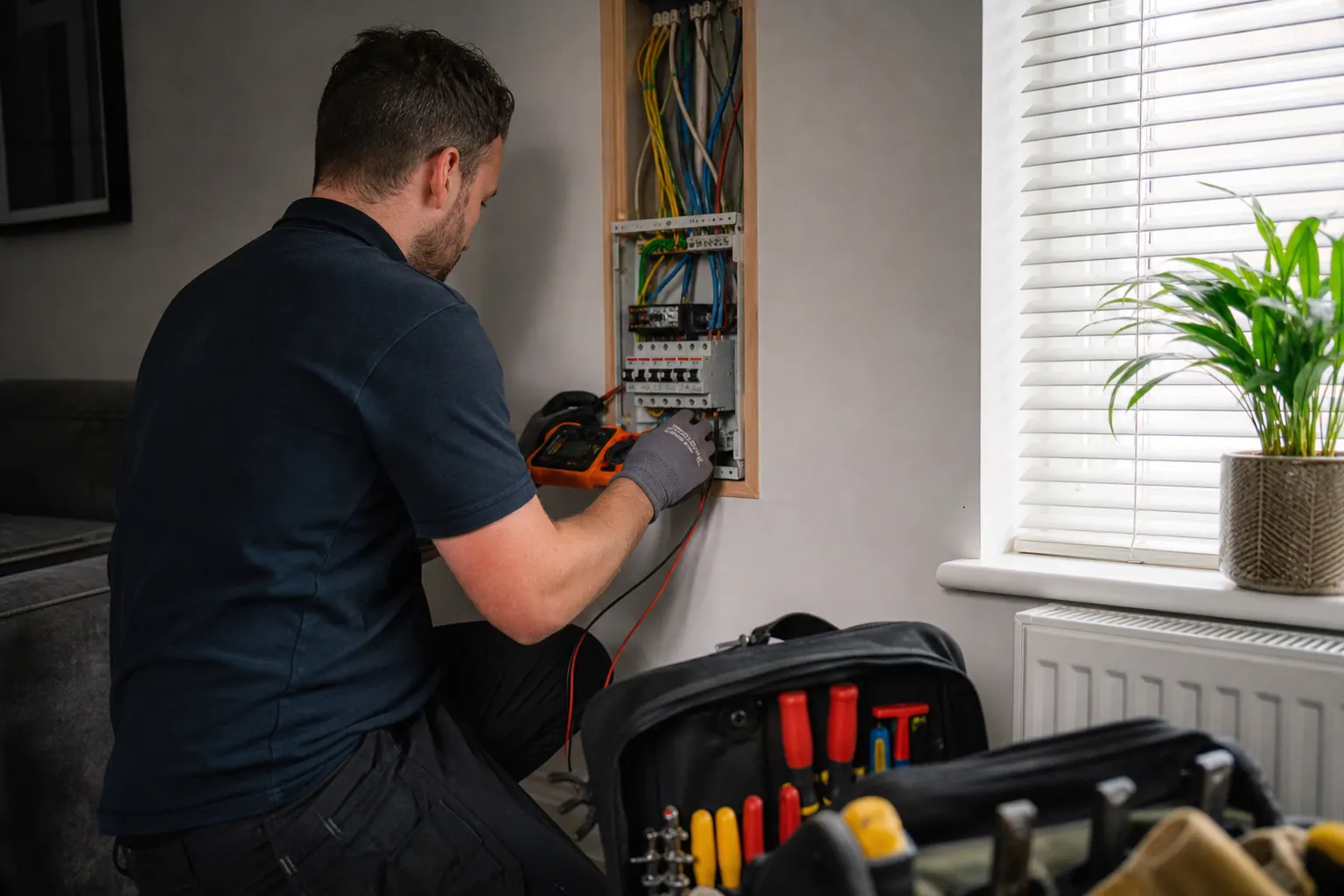
The work has two parts: a visual inspection and testing. The electrician first looks over the consumer unit, wiring where it can be seen, accessories and any signs of damage, overheating or unsafe additions. They then carry out tests on each circuit with calibrated test equipment, checking things like continuity, insulation and the protective devices.
To test safely, the power has to be switched off to parts of the property, usually one circuit at a time and sometimes for the whole supply for a short spell. Plan around anything that needs constant power, such as computers, freezers or medical equipment, and tell the electrician about them beforehand.
The electrician will need to reach the consumer unit and open a sample of sockets, switches and fittings. Clear the way to these before they arrive.
How long it takes and what changes the time
For a typical three-bedroom house, the on-site checks are often done in a few hours. A flat can be quicker. A large, older or heavily extended property takes longer. The main factors are:
The number of circuits and how many outlets each one has.
Access: locked rooms, furniture, loft hatches, outbuildings or a consumer unit that is hard to reach.
The age and condition of the installation, since older wiring and mixed-era alterations take more investigation.
Extra buildings such as garages, garden offices or workshops with their own supply.
Commercial premises, which usually have more circuits, distribution boards and data or specialist equipment to work around.
These same factors move the price. EICR pricing might be a fixed price based on the size of the property, or it might depend on time and the number of circuits. Ask for a written quote that says what is included, and check whether any extra visits or remedial work are charged separately.
The report and what happens if it fails
After the on-site work, the electrician completes the report. You may get it the same day or shortly after, depending on how the work is done, so ask when to expect it.
The report gives an overall result of satisfactory or unsatisfactory, and lists any observations with codes. C1 means danger is present. C2 means potentially dangerous. FI means further investigation is needed. C3 means improvement is recommended. A C1, C2 or FI code normally makes the report unsatisfactory, which is what people mean by a fail.
A fail is not a penalty. It is a list of what needs attention. You can ask for a quote for the remedial work, and the electrician can then confirm the problems are fixed. Landlords in particular should keep the report and act on it promptly, because tenants and local authorities may ask to see it.
How often to have one and how long it lasts
An EICR does not expire on a set date. The report recommends when the next inspection should happen, based on the condition it found. For an owner-occupied home, a gap of around ten years is commonly suggested, and a shorter gap for older installations. For rented homes, landlords are generally expected to have inspections at regular intervals, commonly no more than five years. Commercial premises are often checked more frequently.
It is also sensible to arrange one when buying a property, after a major alteration or if you notice warning signs such as flickering lights, warm sockets, tripping circuits or a very old fuse board. Rules can change, so check GOV.UK for the current position that applies to you.
Common questions
How long does an EICR certificate take to arrive?
It depends on the electrician. Some provide the report on the day and others send it shortly afterwards. Ask when you book, especially if you need it for a tenancy or a sale.
Will the power be off for the whole inspection?
Usually not. Circuits are normally isolated one at a time, with the full supply off only for short periods. Tell the electrician about any equipment that must stay on.
Does an EICR include PAT testing?
No. An EICR covers the fixed installation. PAT testing covers portable appliances and is a separate check.
How long does it take to qualify as an electrician in the UK?
It usually takes several years of combined training and on-site experience, often through an apprenticeship. Ask any electrician you hire about their qualifications and registration.
Useful sources
- NICEIC: The electrical contracting body, with a register to check an electrician.
- GOV.UK: electrical safety standards in the private rented sector: The official guidance for landlords, tenants and councils on electrical safety checks.